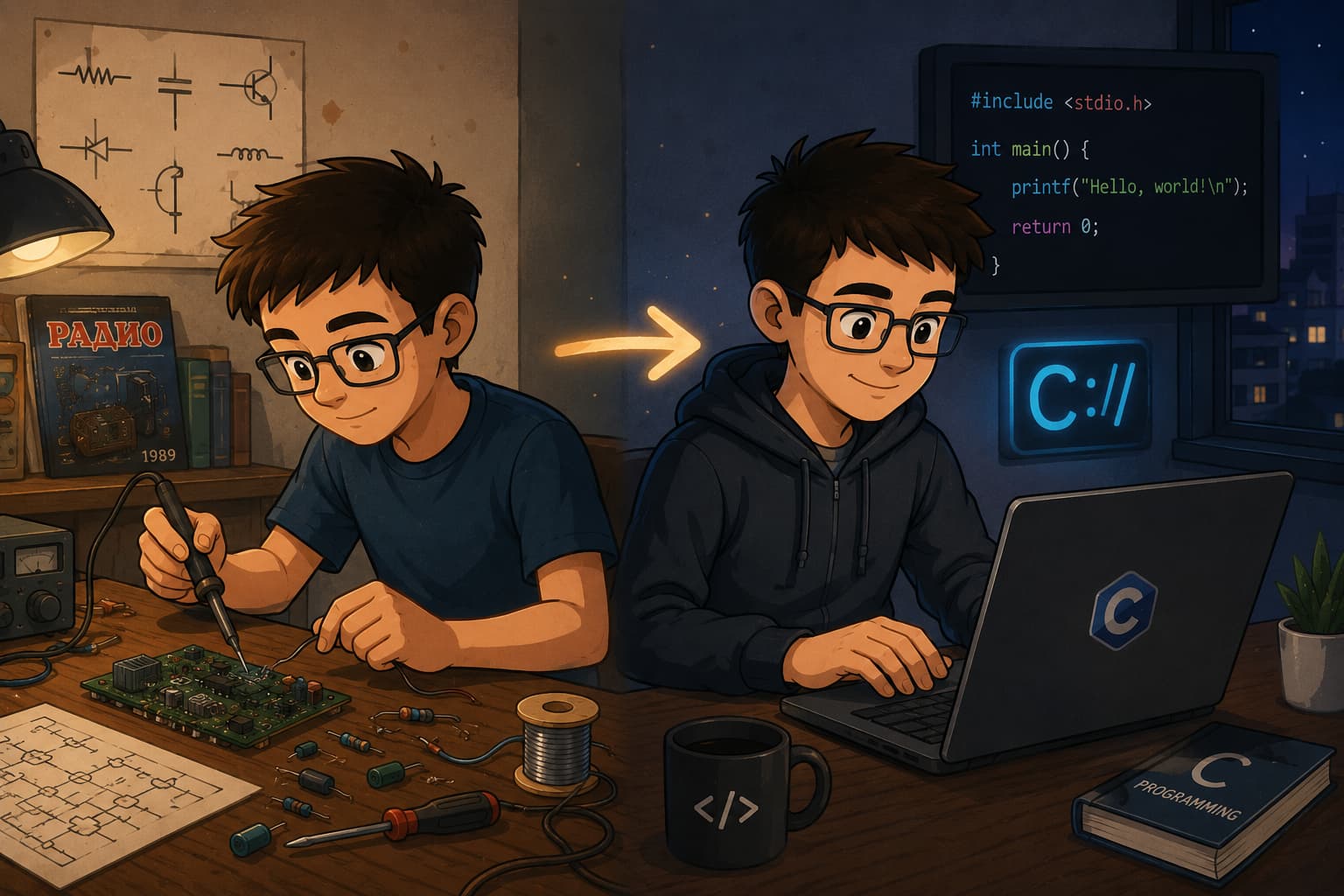
Somewhere around 6th or 7th grade, I became interested in radio electronics. I read old electronics magazines and tried to understand circuit diagrams: what each symbol meant and how everything worked.
One summer, I was staying at my grandmother’s house in a village in Ukraine. My aunt, my mom’s sister, was there too. In the evenings, we sat together with a notebook. She drew symbols of electronic components from circuit diagrams and explained how resistors, capacitors, and other parts worked.
I spent my summer vacations in Ukraine, but at that time I lived in Yakutia, in a city called Neryungri.
After the summer break, when school started again, my father bought me several books about electronics. They explained the theory in a good order, and there was also practice. I assembled and soldered different devices.
Later, that curiosity also led me to build old computers in high school.
By the end of 7th grade, I slowly got to microelectronics. I dreamed about working at Intel, but back then it felt impossible. I lived in a small town surrounded by taiga and snow, so Intel felt like something very far away and unreachable.
The turning point happened one winter morning. My father was driving me to school and asked me an interesting question that changed everything: “Electronics, hardware — it is like a body without a soul. Don’t you want to try programming? To give a soul to soulless hardware?”
Then he showed me how to write programs in C. Later, I found a couple of assembly language books among his books. And that was it…
Yes, my first programming languages were C and assembly.
I wrote different funny programs that rewrote the boot sector and showed different messages before Windows continued loading. Well, not always successfully 😅
At that time, I knew almost all BIOS and DOS interrupts. Now I don’t remember any of that.
When we studied Basic and Pascal in computer science classes at school, it felt easy after C and assembly.
A couple of times, my classmates and I went to a city programming competition. It was fun.
Then I discovered C++ and Borland C++ Builder 6. I loved how easy it was to create Windows desktop applications with it.
As I wrote in one of my previous posts, in 10th and 11th grade I worked in the computer science classroom at school. Around that time, I started making web pages with HTML and CSS and writing backend code in PHP.
In 2006, we moved, or actually returned, to Ukraine, to Kyiv. I entered university and started looking for a job.
At first, it was freelance work. I made templates for Joomla CMS. Then I had a couple of projects where I built websites with MODx CMF.
For one year, I worked at the same university where I studied. I worked on the website for the university newspaper.
After that, I freelanced for a couple of web studios. I worked with one of them for three years. All of that was website development and support in PHP.
Then I worked for a couple of years at Ukr.Net on the Avtosale.ua project. It does not exist anymore.
In May 2015, I joined Magento. It was the right decision. At Magento, I met many great developers and just good people.
In 2017, I flew from Kyiv to Austin, Texas, for a business trip. After that trip, I really wanted to at least visit the U.S. with my family for vacation.
But one year later, Adobe acquired Magento. In the second half of 2018, we were told that the Kyiv office would be closed, and we were offered relocation to Austin.
To be honest, I thought about moving or not moving for about two weeks. My wife and I decided that it was worth trying.
And this is how I have been living in Texas for seven years now and working at Adobe.
In my school years, I dreamed about microelectronics and working at Intel. But life turned out differently, and now I work as a software engineer at Adobe.
At bados.dev, you can see my whole journey in programming.
What is your story?
Leave a Reply